Traveling with a mobility scooter: planes, cruises, cars and theme parks
Last checked: November 26, 2026. Rules change and every airline, ship and park can be stricter than the baseline, so confirm with them before you go.
Written by Roland Trevino.
Travel with a scooter is very doable. It mostly comes down to three things: knowing your scooter's battery type, measuring it, and telling the airline, cruise line or park what you are bringing before you show up.
Roland has flown with his scooter on United, American, Aegean and Delta. The airline notes later on this page are from each airline's official pages. Roland's own boarding process is described below. This article does not invent anything beyond what he has shared.
Roland's scooter, in Pride's own numbers
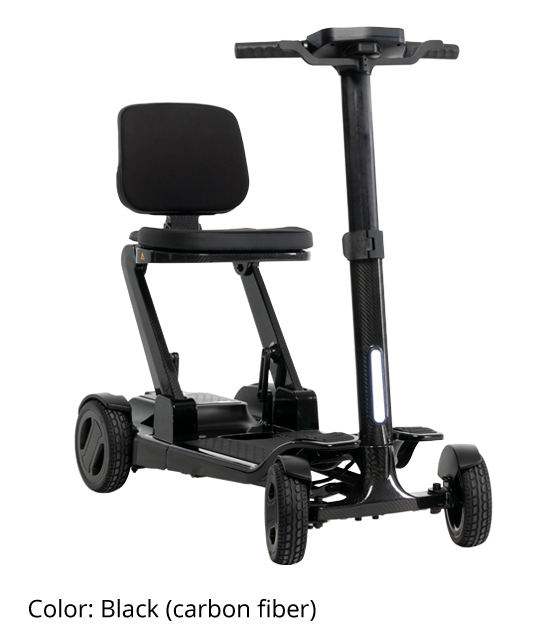
Roland uses a Pride Mobility Go Go Carbon (model SC25M) with a lithium-ion battery. Pride's U.S. pages say it is a four-wheel scooter that folds in seconds and can be towed like luggage; it weighs 35 lbs. without the battery and 39 lbs. with it; and it measures 17.5 inches wide by 40.3 inches long (Pride notes a possible 3% variance). The battery is listed as 24V, 12Ah lithium; Pride lists 288 Wh. Pride's product page calls that pack "airline compliant," and the lithium-battery page still says transport is subject to federal rules and airline policy, so consult the airline before you fly. Pride lists 288 Wh, which is under the FAA's 300 Wh ceiling for a removed or spare lithium-ion mobility battery. More specs, and a note about a conflicting "AGM or gel" footnote on the specifications table, are in the battery guide.
Roland's experience
When Roland flies, his scooter is checked at the plane door, not at the gate. He rides it down the jet bridge to the aircraft door, removes the battery there, and carries the battery on board. The scooter goes in the cargo hold with strollers and wheelchairs.
The Go Go Carbon has a carbon-fiber frame light enough that his wife carries it easily, so it can be taken just about anywhere. The battery is about the size of a book and connects and disconnects with one button. It folds to about carry-on-luggage size, with an extendable handle, so it rolls like airport luggage on wheels.
Door-side handling can vary by airline and airport, so confirm with your airline how they will take the scooter and where they want the battery removed. Some official airline pages use "gate" wording, such as checking a device at the gate or asking a gate agent for a delivery tag. Those lines later in this article follow the airline's own language. Roland's process, as he describes it, is the plane-door handoff above.
Flying with a mobility scooter
Airlines must take your scooter. Under U.S. Department of Transportation (DOT) rules, an airline must accept a battery-powered wheelchair or similar mobility device, battery included, as checked baggage, as long as the baggage compartment size and aircraft airworthiness allow it. There is no extra charge for it.
Powered scooters go in the cargo hold, not the cabin. Airlines are only required to carry manual wheelchairs in the cabin. Most battery-powered chairs and scooters are too large and heavy for the seating area. The airline must return it to you promptly, as close to the aircraft door as possible, unless you ask to pick it up at baggage claim.
Arrive early and give notice. An airline may require you to check in one hour before the general public's check-in time if you travel with a battery-powered device. DOT says passengers generally do not have to give advance notice, but it recommends calling ahead to arrange loading and stowing of your device. An airline may require up to 48 hours' notice for hazardous-materials packaging of a wheelchair battery, or to carry a powered wheelchair on an aircraft with fewer than 60 seats. Give the airline your device's size, weight and battery type.
If it is damaged. On domestic flights, an airline is liable for a damaged assistive device up to its original purchase price. On international flights the limits come from international treaty and may cover less.
Battery rules by type
The FAA's PackSafe page lists these baseline rules.
- Lithium-ion, installed and protected by the scooter's design: the battery stays on the scooter, the scooter is checked (not carried on), and you tell the airline where the battery is. You may bring one spare lithium-ion battery up to 300 Wh, or two spares up to 160 Wh each, in carry-on only.
- Lithium-ion, not adequately protected: the battery has to come off, ride in your carry-on with the terminals protected from short circuit, and each battery must be protected from damage, for example in a protective pouch.
- Gel-cell, absorbed-electrolyte or other non-spillable (sealed) batteries: the battery may stay installed if it is securely attached and protected. One spare is allowed per passenger under the airline's instructions, with strong rigid packaging.
- Spillable (wet) batteries: the battery may stay installed if secured, protected, and kept upright. The airline may need to remove and package it if the scooter cannot be stowed upright.
- Non-rechargeable lithium metal batteries are forbidden with these devices.
- Airlines can be stricter. The FAA notes that individual airlines may have more restrictive rules on dangerous goods.
How to check your battery's watt-hours. Multiply voltage by amp-hours. As a made-up example, a 24-volt, 12-amp-hour battery would be 288 Wh. Your scooter's manual or the label on the battery is the place to find the real numbers.
At the airport
- Airport wheelchair service comes from your airline, not TSA.
- Screening. Tell the TSA officer before screening if you cannot stand or walk independently. TSA officers screen wheelchairs and scooters, including seat cushions and non-removable pouches. Removable items go through the X-ray. If you cannot stand or walk, you may stay seated in your mobility device.
- Canes, crutches and walkers must go through X-ray screening.
- Extra help. You can ask for a TSA Passenger Support Specialist. TSA asks you to contact TSA Cares (855-787-2227) at least 72 hours before departure.
Airline notes (United, American, Aegean, Delta)
Roland has flown with his scooter on these four airlines. What follows is each airline's published policy, checked Nov 26, 2026. It is not a full trip report. Roland's own process — checking the scooter at the plane door, not at the gate — is described above. Confirm the live page before you fly; airlines can be stricter than the FAA baseline.
United
- It is free to check a wheelchair or mobility device, including electric scooters, in addition to checked bags. You can check it at the ticket counter or the gate.
- United asks you to let them know you have a mobility device before you get to the airport, and recommends arriving an hour before your minimum required check-in time.
- Attach written instructions, or United's wheelchair information form, so ground staff know the battery type and how to handle the device. United says it will remove removable pieces only if your written instructions allow it.
- For lithium-ion batteries: if the battery is in a protective casing, United says the device is loaded with the battery attached (upright or on its side, then placed upright in the hold). If it is not in a protective casing, the battery must be removed and stored in your carry-on, and you must tell a flight attendant you have brought the battery on board.
- If your trip includes a carrier other than United or United Express, and the device uses a lithium-ion battery, United says there may be extra steps and you should contact the other carrier.
American
- For battery-operated mobility devices, American tells you to contact Special Assistance to make sure the battery type is approved, and to make other assistance requests as far in advance as possible. Special Assistance: 800-237-7976.
- Batteries must be labeled by the manufacturer with the type (lithium ion, non-spillable dry cell, or wet cell).
- American suggests arriving at your departure gate 1 hour before scheduled departure, and checking with the gate agent for a gate delivery tag to attach before boarding.
- Non-collapsible scooters or other battery-powered wheelchairs can be checked at the ticket counter. Removable parts (cushions, controls and similar) can come into the cabin and do not count toward the carry-on limit.
- Starting March 31, 2027, American will require the lithium-ion battery to be removable and to travel with you in the cabin, rated at 300 Wh or less, with the watt-hour rating visible on the manufacturer's label. Devices with non-removable lithium-ion batteries will not be accepted on or after that date. You may bring one spare up to 300 Wh or two up to 160 Wh each, in the cabin. American says these new rules do not apply before March 31, 2027. Pride lists the Go Go Carbon battery at 288 Wh and as removable from the scooter (35 lbs. without it, 39 lbs. with it).
Aegean
- Request special assistance when you book, or at least 48 hours before the flight, through booking or the Aegean call center at (+30) 210 6261000. Passengers traveling with a wheelchair that has a lithium or lithium-ion battery should make the request through the call center. Arrive at the airport at least 120 minutes before the flight. Up to two items of mobility equipment are carried free, and are not part of the standard baggage allowance.
- Wet-cell (spillable) batteries are not accepted.
- For a wheelchair with a lithium-ion battery, Aegean's extra-details page says pre-notification is required, the battery must be removed and carried in the cabin, and Aegean accepts wheelchairs with collapsible lithium batteries under those packing rules. The limit is up to 300 Wh if there is one battery, or up to 160 Wh each if there are two. Pride lists the Go Go Carbon as a folding scooter with a 288 Wh lithium battery that comes off the frame. Still confirm with the call center before you fly.
- Aegean's general dangerous-goods page also sets tighter watt-hour limits for ordinary spare batteries and power banks. Those general consumer limits are not treated here as the mobility-device rule; the wheelchair lithium-ion section above is the one that names wheelchairs.
Delta
- Delta transports manual and battery-powered devices. Tell Delta about the device at least 48 hours before you fly (Fly Delta app, My Trips, or 404-209-3434), including for lithium-ion batteries, so staff can follow federal dangerous-goods procedures.
- Print Delta's Mobility Device Handling Form, bring it with you, and attach it to the scooter (a gate agent can help). Include disassembly instructions and the battery type.
- At the gate, Delta says to detach and carry on removable parts such as a seat cushion, and to tell the agent whether you want the device brought back to the jet bridge on arrival or sent to baggage claim.
- On lithium-ion batteries, Delta's wheelchair page says "Lithium-ion batteries have no restrictions" and to follow the "Bring Your Personal Wheelchair" steps. Delta's personal-care page is more specific: lithium-ion mobility batteries that meet federal restrictions are allowed; if the battery is easily removed you may bring two spares under 160 Wh or one spare under 300 Wh; if the battery is an integral part of the device, that page says there is no battery size limit; terminals must be protected from short circuit and the battery must have been tested to UN Part III, Section 38.3. Read both pages and confirm with Delta. Pride lists the Carbon battery as a removable 288 Wh pack.
Cruises
Cruise lines let you bring a scooter, but the stateroom door is the limit. Rules below are from two lines' own pages; other lines differ.
- Royal Caribbean: you may bring and use mobility scooters. They must be stored and recharged in your stateroom, so corridors and elevator lobbies stay clear. A standard stateroom door is at least 23 inches wide; accessible staterooms have wider doors (32 inches or more). Their special-needs form asks for the scooter's dimensions, weight, battery type and whether it folds.
- Carnival: you are asked to bring a scooter that folds or collapses so it can be stored in the cabin. To use a standard stateroom, the scooter must fit through the 22-inch doorway; scooters wider than 21 inches need a fully accessible stateroom (32-inch door), and Carnival may measure your scooter at check-in. A scooter that does not fit will not be allowed on board, and the guest can be denied boarding with no compensation. Only gel, dry-cell, absorbed-glass-mat or lithium-ion batteries are allowed, batteries are charged in the stateroom, and removable batteries are recommended.
- Submit the line's mobility form when you book, not at the pier. Both lines ask for this.
- Ports. Royal Caribbean notes that power scooters may not be taken on tenders unless roll-on access is available.
Getting your scooter into a car
There are three common ways: take it apart, use a lift inside or outside the vehicle, or rent a vehicle with a ramp.
- Hitch-mounted, hybrid, and hoist lifts are the three lift types Harmar describes. A hitch lift carries the scooter on the outside rear of the vehicle; hybrid and hoist lifts are installed inside the cargo area. Hitch lifts need a hitch added if you do not have one.
- Match the weight, not just the fit. A hitch that physically accepts a lift may not have enough tongue-weight capacity. Add the lift's installed weight, the scooter's real weight, and any accessories, then compare to both the lift's capacity and your hitch and vehicle ratings.
- Use a trained dealer. Harmar says to use a qualified authorized dealer for installation and service, and to confirm vehicle compatibility.
- Taking the scooter apart. Many scooters break down into pieces; the process and weights are in your owner's manual.
Theme parks (Florida focus)
- Walt Disney World: devices must have at least three wheels, stay stable when stopped or unoccupied, and run at walking pace. They should be single-rider and no larger than 36 inches wide and 52 inches long. Training wheels and modifications are not permitted. Anything trailer-like pushed, pulled or towed by an electric conveyance vehicle (ECV) is prohibited. Disney's own planning site says buses, the monorail and the Skyliner can carry ECVs, and most boats can, but larger ECVs may not fit.
- Universal Orlando: ECVs can be rented. Apart from the Hogwarts Express, attraction queues and ride vehicles do not accommodate ECVs; at rides that take standard wheelchairs, guests transfer to a wheelchair provided at the ride. Guests in ECVs must transfer to the seat on resort shuttles.
- Measure before you go.
A short checklist
- Find your battery type and, if lithium, its watt-hours.
- Measure width, length, height and weight. Write it down once and reuse it.
- Tell the airline or cruise line what you are bringing before travel.
- Read your own airline, ship or park page; each can be stricter than the baseline.
- Pack the charger and the manual.
Gear that can help
Travel is where spare parts and small accessories matter. Our accessories guide covers what to look for in a travel bag, cover and spare battery, and our battery guide covers charging before and after a trip.
This article shares general information, not legal or medical advice. Confirm every rule with the airline, cruise line or park before you travel.
Written by Roland Trevino. Questions or corrections: hello@mobilitytipsguide.com